
GREEN STAR

CANSAT 2025/2026

Reach for the Stars, Plant for the Future

Scroll

CanSat Competition

What is CanSat?

CanSat is a simulation of a real satellite, integrated within the volume and shape of a soft drink can. The challenge is designed by the European Space Agency (ESA) to give students hands-on experience in designing, building, and launching a satellite.

The Challenge

Teams must design and build a CanSat that measures temperature and air pressure during descent from a height of approximately 1km. The data must be transmitted to a ground station and analyzed in real-time.

Our Approach

Green Star combines cutting-edge technology with environmental consciousness. Our CanSat features precision sensors, reliable telemetry, and an innovative seed dispersal system for our secondary mission.

Our Team

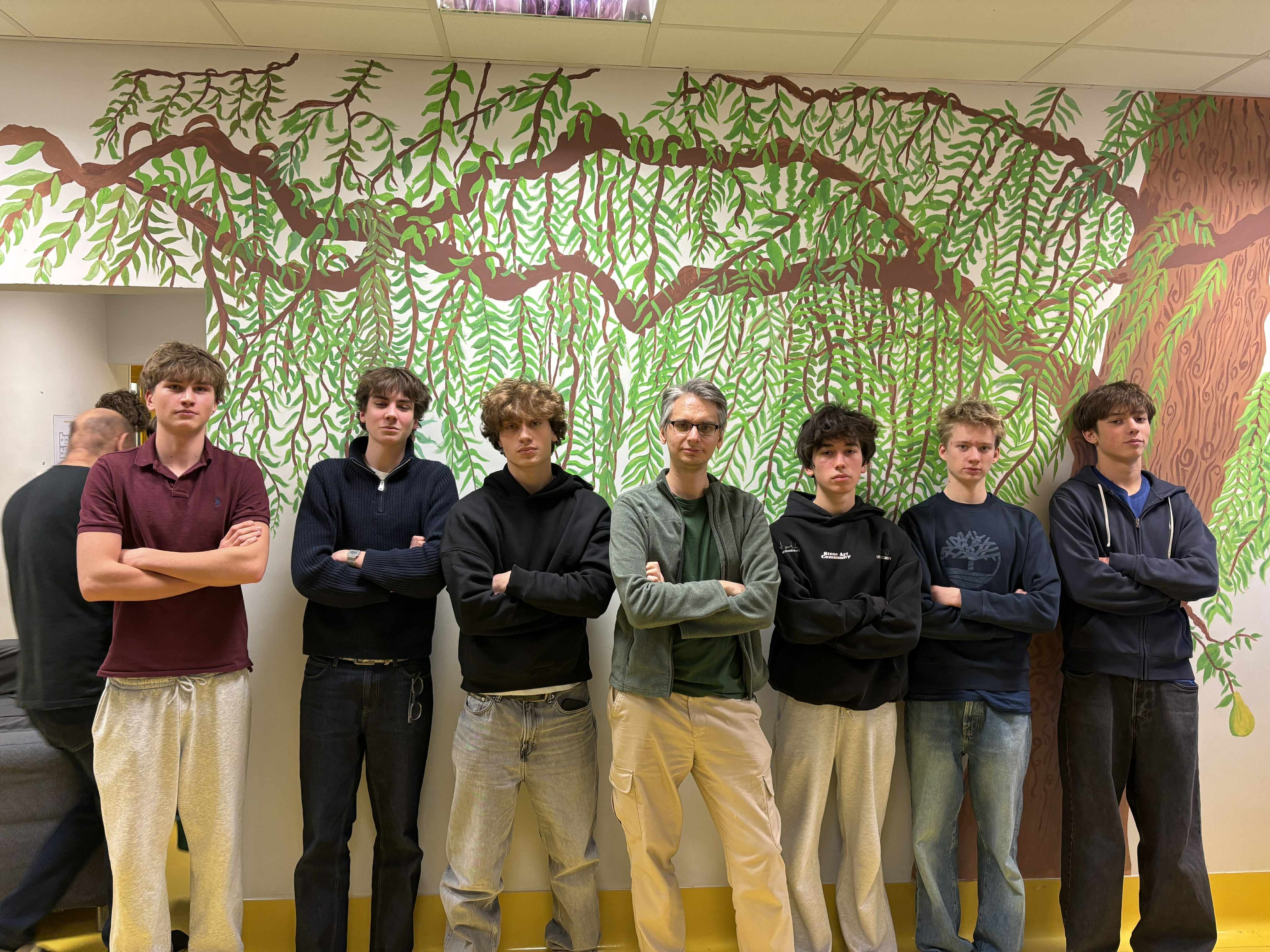
Group photo

The Green Star CanSat Team 2026

We are a team of six high school students from PaweΕ‚ Jasienica 2SLO High School in Warsaw, Poland. As students of the IB Diploma Programme, we are passionate about STEM, including engineering, programming, physics, mathematics, and astrophysics.

The CanSat competition is an opportunity for us to develop practical skills and learn through experience, rather than relying solely on theory.

DP

Dominik Palikowski

Team Leader

Leading the team and coordinating all project activities from concept to launch.

IR

Igor Rybkowski

Technical & Software Design

Developing firmware, software architecture, and technical systems integration.

AN

Antoni Nowak

Electronics & Finance

Designing electronic systems, sensor integration, and managing project budget.

AO

Aleksander OrΕ‚owski

Ground Station & Recovery

Building the ground station systems and designing the recovery mechanism.

TM

Tomasz Morek

Outreach & Finance

Managing social media, sponsor relations, and financial planning.

MS

Mateusz Sarna

Ground Station & Recovery

Developing telemetry systems and recovery procedures.

PM

Piotr Morawiecki

Mentor

Faculty advisor providing guidance and expertise throughout the project.

Our Mission

Primary Mission

Our primary mission is to prototype a CanSat mini-satellite that will be launched aboard a rocket to an altitude of around 3000 m. Once ejected, the CanSat will automatically detect the descent phase by monitoring changes in altitude computed from air pressure measurements.

  • Measure air pressure and temperature throughout the flight
  • Calculate real-time altitude from barometric data
  • Compute wind speed and air density during descent
  • GPS tracking for precise position logging
  • Continuous data transmission to ground station
  • Simultaneous data logging to SD card for post-flight analysis
  • Maintain radio communication after landing for easy recovery
πŸ›°οΈ CanSat Motherboard Click components to learn more

Secondary Mission

Our innovative secondary mission focuses on environmental sustainability. When the CanSat descends to approximately 100 m above the ground, its onboard computer will trigger a capsule-deployment mechanism, releasing cellulose capsules filled with seeds.

  • Automated altitude detection at ~100 m above ground level
  • Precision triggering of capsule-deployment mechanism
  • Release of biodegradable cellulose capsules containing seeds
  • Controlled seed dispersal for environmental reforestation
  • Post-landing beacon transmission for device recovery
  • Analysis of deployment accuracy and seed distribution patterns

3D CanSat Model

3D satellite model

Interactive 3D model of our satellite design. Drag to rotate, scroll to zoom.

πŸ–±οΈ Drag to rotate β€’ Scroll to zoom β€’ Double-click to reset

Mission Simulator

CanSat Descent Simulation

Wind: 3.0 m/s β†’
☁
☁
☁
3000m
2000m
1000m
100m
0m
100m
80m
60m
40m
20m
10m
0m
LANDING ZONE
πŸ”₯
GS
READY
T-00:00
1x
Wind: β†’ 3.0 m/s
Drift: 0m
ALTITUDE
0m
VELOCITY
0m/s
TEMPERATURE
15.0Β°C
PRESSURE
1013.3hPa
// MISSION LOG
[T+0.0s] System initialized. Ready for launch.

Project Timeline

September 2025

Team Formation

Green Star team assembled and registered for CanSat 2025/2026.

October 2025

Preliminary Design Review

Initial designs and component selection.

November 2025

Prototype Development

Purchasing components and building first prototypes.

December 2025

Initial Testing

Beginning to test components and search for sponsors.

January 2026

Critical Design Review

Final component tests, developing the final satellite.

February 2026

Finalizing the Design

Using the jury's comments to develop the final design.

March 2026

Final Design Review

Finalizing everything, writing the last design report.

April 2026

Launch Campaign

Launching our satellite in the air and presenting our progress to the jury.

Partners & Sponsors

We are grateful for the support of our partners and sponsors who help make our mission possible.

Become a Partner

Interested in supporting the next generation of space engineers?

Get in Touch

Contact Us